
GUIDE TO VAPOR PHASE CARBON DRUMS
What to do when VOCs show up at your site.
Global Environmental's practical guide gives environmental contractors, facility managers, and site engineers a field-ready reference for vapor phase carbon drums. From drum selection to deployment to ongoing operation, it covers what you need to know before the project starts and as it evolves.
Learn how to match the right drum configuration to your application, understand key performance specs, and know when it's time to scale up so your site stays compliant and your project stays on track.
Learn how to match the right drum configuration to your application, understand key performance specs, and know when it's time to scale up so your site stays compliant and your project stays on track.
VAPOR PHASE CARBON DRUMS IN THE FIELD
Vapor phase carbon drums are one of the most versatile and accessible tools in environmental remediation.
Knowing how to deploy them correctly makes all the difference. When a project calls for reliable VOC and odor control, carbon drums are built for the job. But the wrong configuration or a mismatched flow rate can mean compliance risk and project delays. Getting it right starts before the drum hits the site.
Download Guide
Download Guide
UNDERSTANDING YOUR EQUIPMENT
Picking the right drum matters as much as deploying it.
Not every application has the same demands. Before selecting a drum, gather the essential facts about your project to ensure the right fit.

What VOCs or gases are present, and what are the expected concentrations?
What is the system's flow rate, and does it fall within the drum's 200 SCFM maximum?
Is this a short-duration project, or will the drum need to support repeated changeouts over an extended operation?
Are inlet air conditions, including moisture levels and temperature, within the drum's operating limits of 140°F and 10 PSI maximum?
VAPOR PHASE DRUM CONFIGURATIONS
Two configurations. One straightforward decision.
The difference between the two configurations comes down to project duration and budget. One is built to last through repeated carbon changeouts. The other is engineered to get on-site fast and go straight to disposal when the work is done.
VPD-200 — Built to Order: Designed for durability, serviceability, and long-term performance. Built with a drum liner, heavy-duty gaskets, and optional welded fittings for repeated carbon changeouts. Pressure gauges, valves, and sample ports are available upon request.
VPD-200D — Ready to Ship: A light-duty, single-use configuration built for speed and cost-efficiency. It ships ready to deploy and is intended for direct disposal after project completion, eliminating changeout logistics and storage overhead.
Media Capacity: Each drum holds 200 lbs. of vapor phase activated carbon with a max flow rate of 200 SCFM and a max pressure of 10 PSI.
Scale-Up Ready: When the project grows, Global offers vapor phase carbon vessels in 1,000-, 2,000-, and 5,000-lb. capacities to support every stage from pilot to full-scale.
COMMON VAPOR PHASE DRUM APPLICATIONS
From SVE systems to vapor intrusion mitigation, carbon drums fit the work.
The application determines the approach. Whether you're treating extracted soil vapors, managing a sub-slab system, or controlling emissions from a tank vent, each scenario has its own deployment and monitoring considerations. The guide covers them all.
Soil Vapor Extraction (SVE) Systems
Carbon drums integrate directly into the SVE treatment train alongside blowers and extraction wells. On shorter-duration or pilot-phase projects, drums keep upfront costs low, mobilize quickly, and generate the data needed to inform long-term system design.
Sub-Slab Depressurization & Vapor Intrusion Mitigation
Drums provide a compact treatment solution for capturing VOCs drawn from beneath a structure before they enter the indoor environment. They pair efficiently with small blowers and are well-suited to the lower flow rates typical of building-level mitigation systems.
Tank Venting, Odor Control & Indoor Air Scrubbing
Storage tank vents and process emissions releasing VOC-laden air can be managed with a carbon drum placed inline. Drums can also be deployed as portable air scrubbers in occupied indoor spaces during active remediation, post-spill response, or ongoing mitigation.
SVE Pilot Testing & Feasibility Studies
When the goal is to evaluate system performance before committing to full-scale equipment, carbon drums are an ideal pilot testing tool. They keep upfront costs low, mobilize quickly, and generate the treatment data needed to inform long-term system design.
Recent Projects
All Projectsᐳ
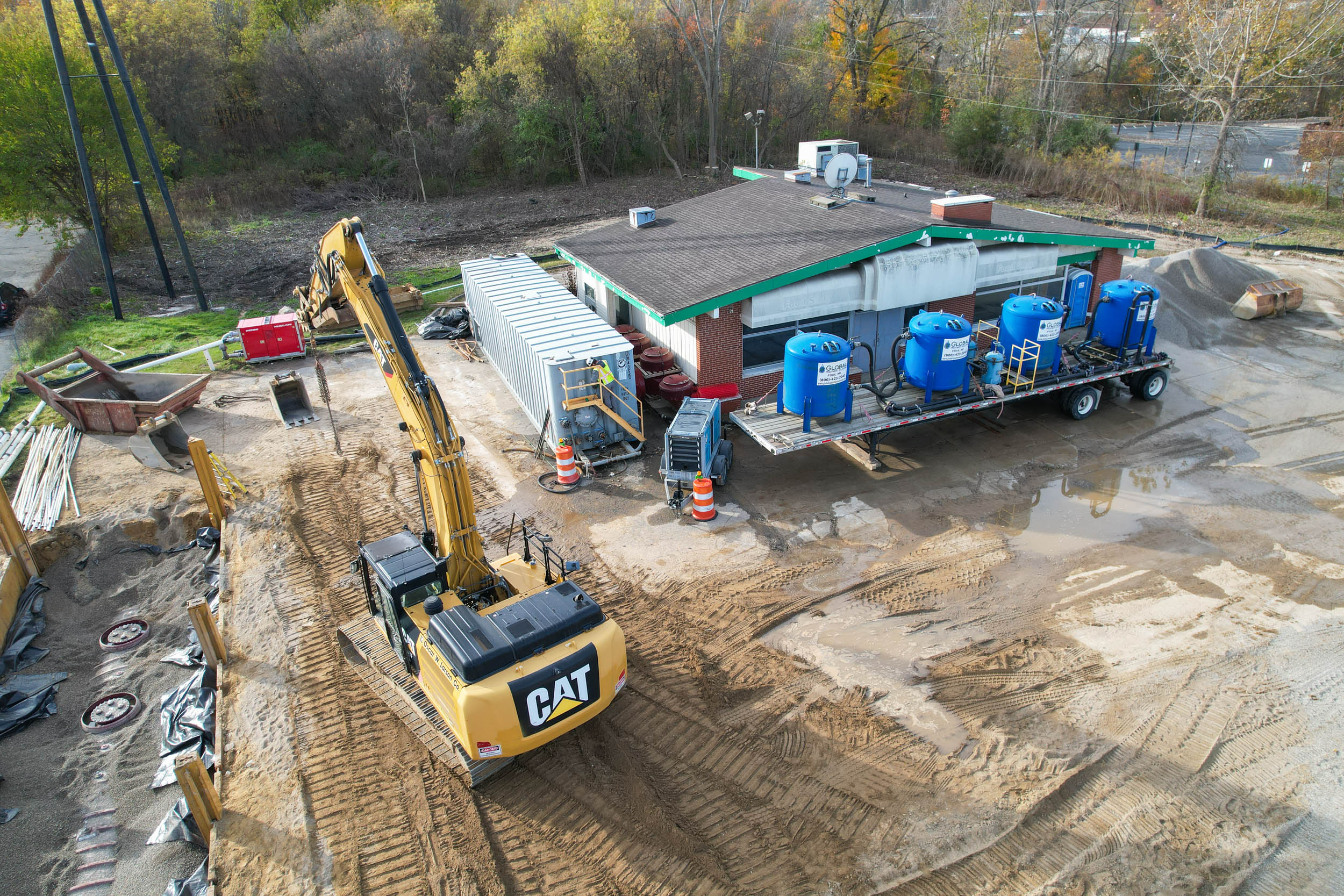


The right drum is out there. Let's make sure you're using it.
Whether you're scoping a new project or already in the field, Global Environmental can help you identify the right configuration, get equipment on site quickly, and keep your system running. Our process starts with a free consult to understand the specific needs of your project.


